 |
||
The texts of the palatial tablets refer to a series of offices and officials. Therefore we have adequate knowledge of the hierarchy of Mycenaean administration. The offices are identifiable by the etymology of the titles, by different legal acts or by the reference to accidental events which are related to administrative matters. Indicative elements of the hierarchy are also the post of the officials in the landholding system and the privileges. The hierarchical step and the authorities of the various offices are not always clear. The Wanax,, the king, is at the highest grade of the Mycenaean hierarchy. This supreme monarch ruled the state from the palaces, he made laws and determined the rate of taxes, he directed the collective works and defined the international conditions. As it results from the tablets of Pylos, the Wanax held vast areas of land and allowed only himself to make specific offerings to the gods. His power did not originate from certain administrative procedures but probably from hereditary succession. All references made to the king are in the context of festivals or places of ceremony. Thus, the power of the king was always connected indirectly with cult. The Lawagetas is the second most significant person. He is the one that leads the people. If we assume that in the Mycenaean language, as in Homer's works, the word laós signifies the army, then the Lawagetas was the leader of the army. His duties consisted in imposing the order to the state and leading the army in military operations. The land he owned makes him the second largest landholder after the wanax. Various craftsmen were employed under his service. A different opinion suggests that the Lawagetas was a kind of prince with no military or other power. A group of officials which is also frequently mentioned in landholding texts from Pylos and Knossos are the Telestas,, or telestai. This was a high office. In the list of landholders referred to above, three telestai appear to hold altogether as much land as the wanax. As for their duties, there are two different theories. One of them suggests that they were religious officials and the other persons to whom land had been given in return to services. In the region of Pylos was a large number of telestai. Fourteen of them lived in the cult center Pakijane. The texts of Pylos and Knossos refer to the military cavalry class, the equeta. In classical Athens the horsemen constituted a social class based on income but the Mycenaean word may be mostly related with the Homeric meaning of the hetairos, that is the companion of the king. In Pylos the equeta appear as representatives of the central military authority and as it results from certain landholding texts, they wore a particular kind of garment and ridded on two-wheeled chariots. In addition, they may have slaves. It is most likely that they constituted a small warrior caste attached to the wanax. This caste may be identified with the warriors of a typical category of graves of the Late Helladic IIA and IIIA1 period which were buried with their entire armament. The tablets of Pylos, Knossos and Thebes often refer to the title of the qasireu,, which means king. All the evidence show that in the Mycenaean period this title had not yet acquired the meaning it has in the later Homeric epics. The Mycenaean kings were probably regional leaders and their authority did not surpass the frontiers of a small area or town. In one case, a qasireu is the chief of a group of bronzesmiths. Another view suggests that the qasireu, were persons who derived exclusively from the workshops and had no relation with the administration. |
 |
|
|
|
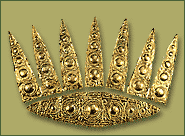
Mycenae, Grave Circle A, Grave III.
Gold diadem with repousee decoration. |
|
 |
||
|
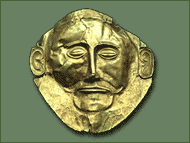
Gold funerary
mask from Mycenae
known as the "mask of Agamemnon". |
||