 |
||
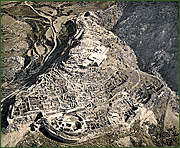
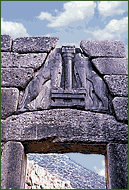
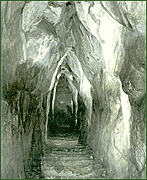
The citadel of Mycenae was built on an inapproachable rocky hill between ravines. Its peak is elevated at 128 metres above sea surface. The total area of the citadel occupies 30.000 m2. The Mycenaean citadel was fortified around 1340 BC with a Cyclopean wall which followed the natural perimeter of the hill. The thickness of the wall is 5.50 m on average and is built with enormous boulders and smaller blocks. The initial height of the wall has not been preserved at any part. However, it is estimated that it was approximately 12 metres high. The citadel had one central and a supplementary gate. The principle northwestern gate which was built around 1250 BC and is called the "Lion Gate", is an imposing megalith which can be compared to the gates of the Hittite town Hattusa in Asia Minor. The relieving triangle, over the gate, bears the representation of two relief confronting lions with their legs on a biconcave shaped altar flanking a Minoan type pillar. The imposing gate of the citadel with the atrocious representation of the lions must have been the emblem of the Mycenaean kings and the symbol of their power for their subjects but also for their foreign visitors. Beyond the gate inside the citadel was a covered court with a small chamber which functioned probably as a guard post. On the right was a building adjacent to the wall which is determined as a granary because of the pithoi with carbonized wheat that were found in it. Along the south wall, in the lower citadel private buildings which are conventionally named after the excavators of Mycenae or the most important finds which were discovered in them, such as the "Tsountas' House", "Wace House" and the "House of the Warrior Vase" were revealed. In the centre of this complex was the "cult centre" of Mycenae in which many cult objects, altars and luxurious apartments inhabited by priests were found. A wide ramp beginning from the lion gate led to the internal part of the citadel and the palace which was situated at the highest peak. From the palatial centre which was built on different terraces only a few rooms are preserved including the megaron of the wanax, a guest house and the palace workshops. The citadel had no water sources. Thus, water was drawn from wells and concentrated in an underground cistern. Access to the cistern was achieved by a corridor with a corbel-arched roof which was built under the north wall. Near the Mycenaean citadel were the royal tholos tombs and the "Grave Circles", where the members of the royal family were buried. The most ancient grave circle, that is Grave Circle B, is situated outside the principle gate. Grave Circle A which is situated southeast to the lion gate was also initially out of the fortification wall. But during the period of the extension of the fortification it was enclosed in the citadel. The less important persons and the citizens were buried in chamber tombs in the greater region. |
 |
|
|
Mycenae. Aerial view of the citadel.
|
||
 |
||
|
Mycenae. The relieving triangle
of the Lion Gate. |
||
 |
||
|
Mycenae.
The descent to the underground cistern. |
||